





The sonic log measures the travel time of an elastic wave through the formation. The design of our tools allows us to record high-quality data even in the low-frequency section (soft formation).
|
All tools are calibrated in accordance with engineering standard. Main uses of the sonic log are: - porosity calculation; - identification of fracturing zones; - identification of fracturing after fracking; - estimation of the elastic formation properties; - reservoir permeability calculation; - estimation of anisotropy and its directions. |
 |
| Measured parameters in open hole: | Measured parameters in cased hole: | ||
| Interval transit time: | Attenuation coefficient: | - Attenuation of the amplitude of an acoustic signal traveling down the casing wall | |
| - P-wave | - P-wave | ||
| - S-wave | - S-wave | - Attenuation of the wave traveling down the casing wall | |
| - Stoneley wave | - Stoneley wave | ||
| Calculated parameters: | CBL calculated parameters: | ||
| - ΔT P-wave | - Poisson's ratio | - Quality of cement bond on the exterior casing wall | |
| - Porosity | |||
| - ΔT S-wave | - Permeability | ||
| - Young's module | |||
| - Anisotropy | |||
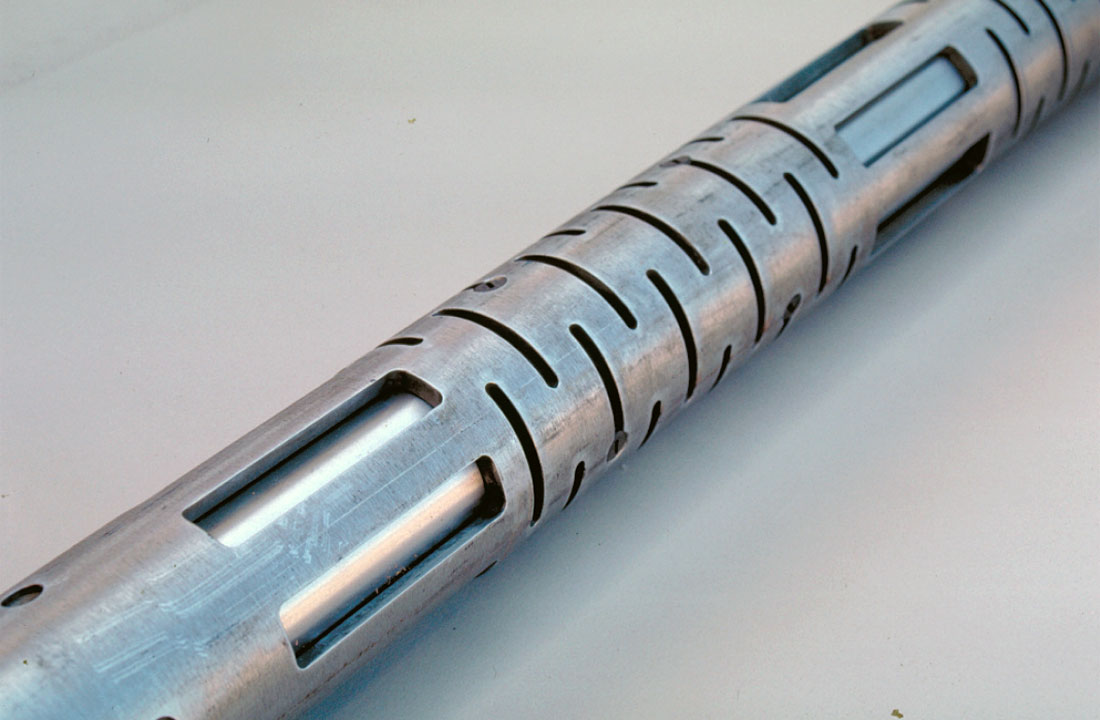 |
Sonic tools: - Full-wave Sonic tool; - Borehole Compensated Sonic tool (BHC); - Long Spaced Sonic (LSS); - Cross-dipole Sonic tool. |
|
Operational P-T conditions:
 |
MAX |  |
MAX | |
| 150; 175 °C | 120; 150 MPa |