





Packer is a standard component of the completion hardware of oil or gas wells used to provide a seal between the outside of the production tubing and the inside of the casing, liner, or wellbore wall.In wells with multiple reservoir zones, packers are used to isolate the perforations for each zone. In these situations, a sliding sleeve would be used to select which zone to produce. Packers may also be used to protect the casing from pressure and produced fluids, isolate sections of corroded casing, casing leaks or squeezed perforations, and isolate or temporarily abandon producing zones. In water-flooding developments in which water is injected into the reservoir, packers are used in injection wells to isolate the zones into which the water must be injected.
|
The slip packer system consists of a packing part (slip packer PSH TTG) complete with a thermal gas generator TTG PSH and a landing pneumatic chamber PPK. Once the thermal gas generator is triggered by the pressure of inert gases, there is a translatory movement of the landing chamber rods, causing tightening force on the packer PSH TTG. Sealing is accomplished with large, cylindrical rubber elements. Once the desired depth is reached, the slips and element must be expanded out to contact the casing. Axial loads are applied to push the slips up a ramp and to compress the element, causing it to expand outward. Then the PPK chamber is detached and pulled to the surface by destroying the breaking pin. The camera can be used repeatedly. Parts remaining in the well, with the exception of the rubber element, are made of cast iron and aluminum alloys . |
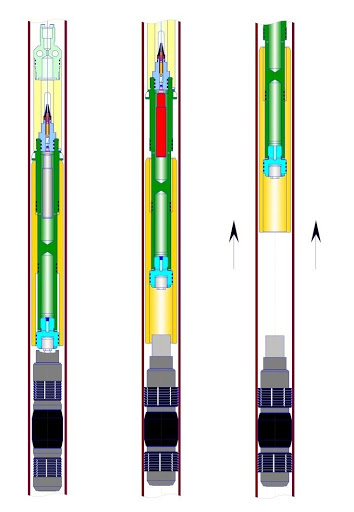 |
If necessary, the packer can be drilled out.
|
Outside packer diameter, mm |
110 |
118 |
135 |
146 |
|
Casing diameter, mm |
|
|||
|
Min |
117 |
125 |
144 |
154 |
|
Max |
124 |
133 |
152 |
164 |
|
Max. pressure, MPa |
150 |
|||
|
Max. temperature, ℃ |
150 |
|||