





Determining hydrocarbon and water saturation behind casing plays a major role in reservoir management. Saturation measurements over time are useful for tracking reservoir depletion, planning workover and enhanced recovery strategies, and diagnosing production problems such as water influx and injection water breakthrough.
Reservoir saturation estimation requires an integrated approach to the study which can be ensured by RK-89 and dual-detector pulsed neutron tools (far and near zone estimation). Saturation tool RK-89 incorporates gamma ray, neutron and neuron-gamma logging modules.
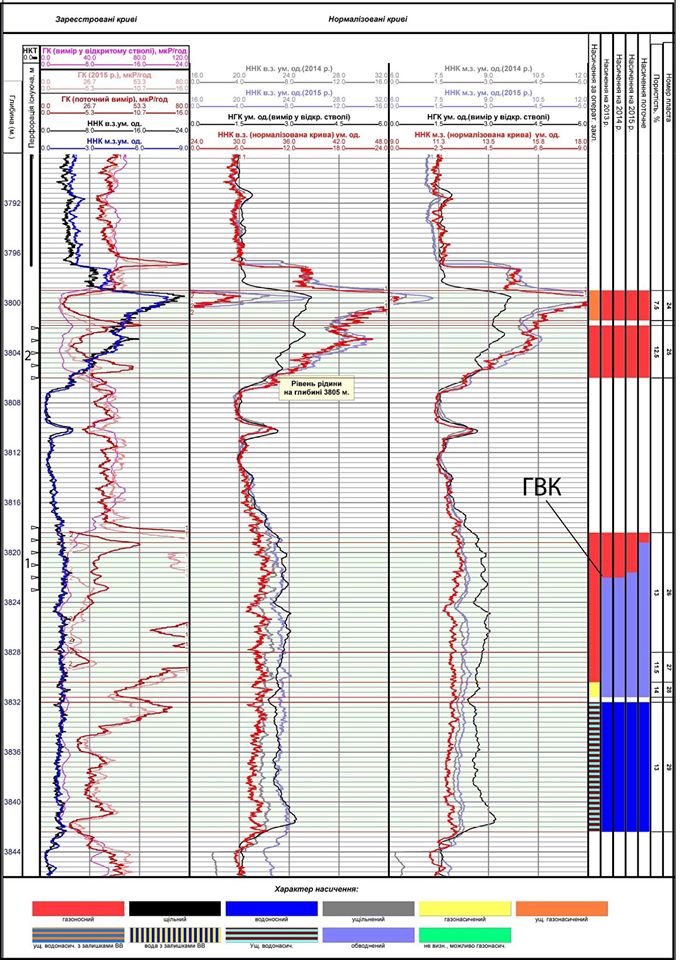 |
Ukrspetsgeologiya LLC in cooperation with S. I. Subbotin Institute of Geophysics developed and patented (Patent number: 117555/Published: 26.06.2017) a five-detector radioactive logging tool for the evaluation of oil and gas wells, consisting of the gamma ray logging module (GR) and dual-spacing thermal neutron logging module (CNL) and dual-detector neuron-gamma logging module. The tool is designed to determine the lithological properties and petrophysical parameters of rocks in cased and open holes. Combination of the above-mentioned tools allows to solve the following tasks: - detection of missed reservoirs, layers and their saturation evaluation; - clarification of reservoir characteristics; - identification of waterflooded layers; - detecting fluid contact position; - appraisal of hydrocarbon saturation after long field exploitation. |
As chlorine and hydrogen have a large effect on the curve readings the well should be either filled with low-salinity fluid or totally dry to enhance the quality of the recordings.
|
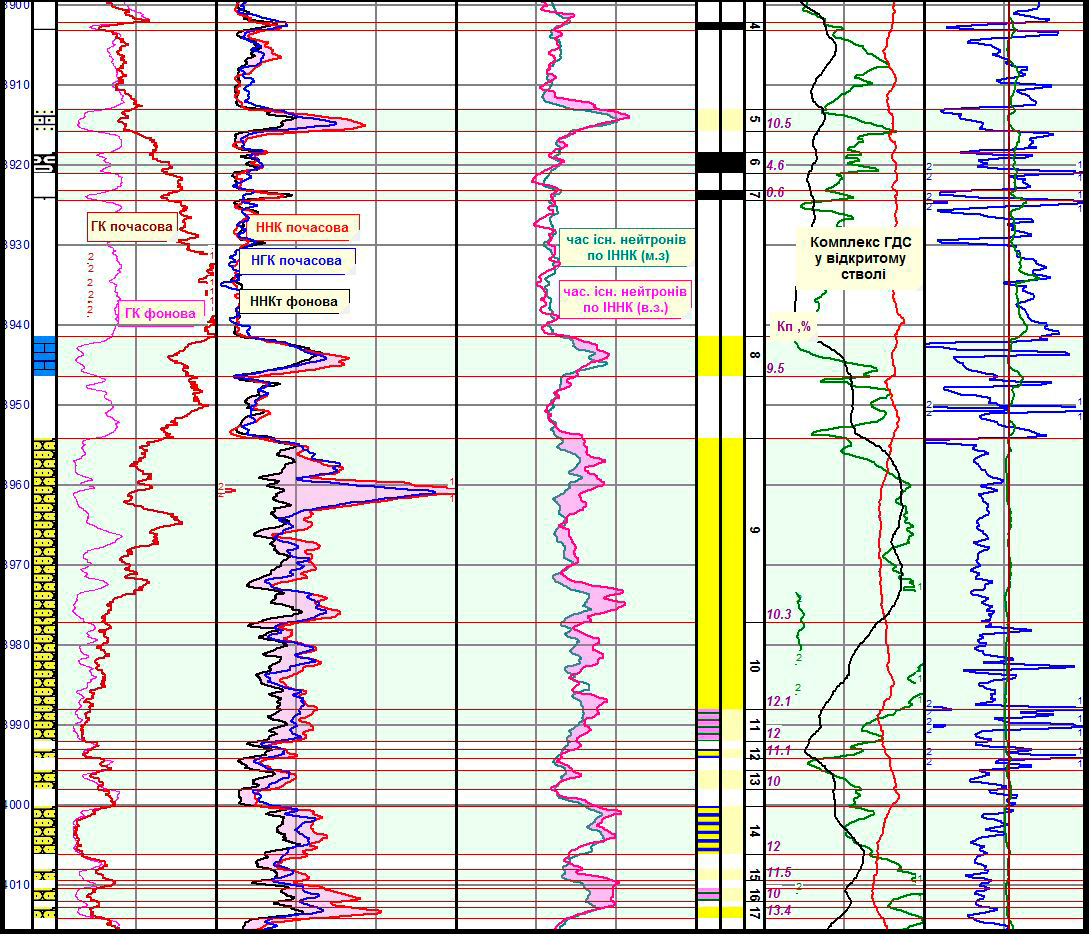
This method is commonly used for reservoir saturation evaluation and identification of the OWC, GOC, GWC. We use the two-detector pulsed neutron logging tool, which allows us to study the distribution of thermal neutrons over time. The use of dual-detector equipment provides registration of the thermal neutrons density for eight time-delay windows on each of the detectors. Once we have all recordings (16 time-delay curves and two integral curves for near and far-spaced detectors) we calculate the neutron lifetime in the near and far zones. Comparing the lifetime of thermal neutrons on far and near-spaced detectors allows us to evaluate reservoir rock saturation more accurately. |
 |
Operational P-T conditions:
 |
MAX |  |
MAX | |
| 150 °C | 120 MPa |