





Casing inspection is an important survey at all operation stages of the well. Holes in tubing or casing caused by corrosion or other damages can seriously affect production rates and fluid composition, resulting in economic loss.
Casing inspection is carried out:
- to monitor the casing/tubing integrity;
- to identify casing splits, defects, metal loss and corrosion area;
- quality control of the well intervention operations (workover).
 |
Casing inspection log is an individual measurement, or a combination of measurements using acoustic, electrical and mechanical techniques, to evaluate the casing integrity. Multi-finger casing caliper logs are mechanical casing inspection devices, using 8 fingers. This tool is aimed to evaluate the casing of oil and gas wells with diameters of 110-300 mm, regardless of fluid type. To provide proper depth matching of all curves, gamma ray and collar locator are integrated into the tool. Multi-finger caliper simultaneously records eight radiuses in a direction from the tool axis to eight fingers. The tool gives high resolution, radially and vertically, to identify inner casing diameter, casing deformation, well ellipticity and axial joint splits. |
Operational P-T conditions:
 |
MAX |  |
MAX | |
| 150 °C | 150 MPa |
Multi-frequency electromagnetic log based on the estimation of spatial distribution of the eddy current through the casing. Once the excitation current is turned off, the electromotive force induced by eddy current registers on the detector coil.
|
We have two tool modifications: - evaluation of the multiple casing strings with a maximum outside diameter of 245 mm and minimum inside diameter of 110 mm and total casing wall thickness up to 25 mm. - evaluation of the casing with a maximum diameter of 180 mm through tubing with inside diameter no less than 52 mm and total casing wall thickness up to 25 mm. Multi-frequency electromagnetic scanner provides effective identification of all casing defects, such as: - multidirectional casing splits; - different local defects (casing deformations, holes, cracks, splits, joint breaks) - corrosion; - metal loss. This method allows us to refine well construction, casing wall thickness of two different strings, identify construction elements, effectively allocate joints and connectors. |
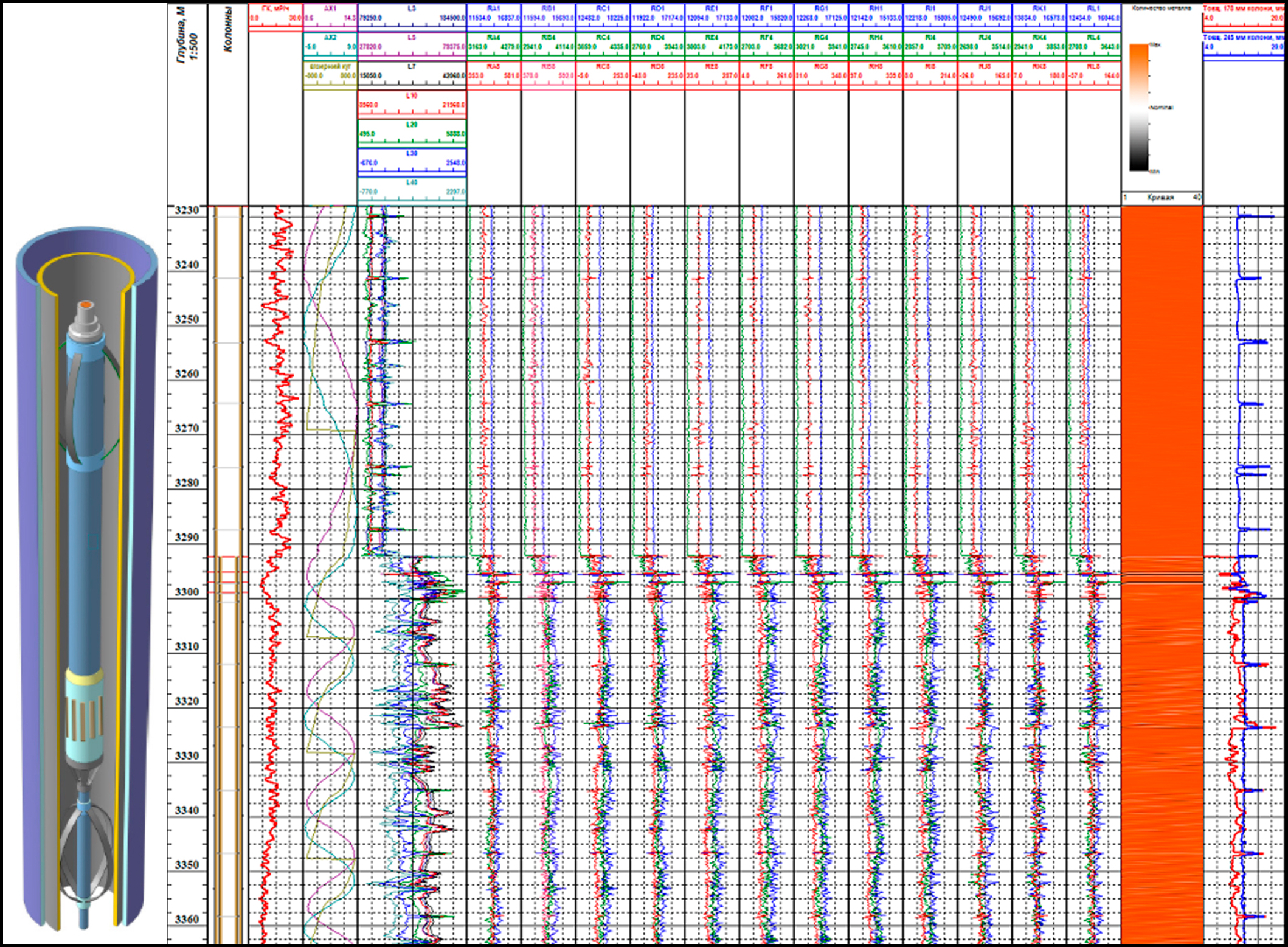 |
Operational P-T conditions:
|
MAX | |
MAX | |
| 150 °C | 100 MPa |
ULTRASONIC IMAGING TOOL (USI)
Ultrasonic imaging tool transmitters emit ultrasonic pulses and measure the received ultrasonic waveforms reflected from the internal and external casing interfaces. This tool works in two modes:
 |
- imager mode mostly applies in the cased hole to identify all possible mechanical defects in casing. The tool can be used in open hole as well. In this mode tool sensor emits ultrasonic pulses with a frequency of 1000 kHz and records 128 reflected waveforms per second, which allows us to scan the entire casing circumferences for full 360° data coverage. |
|
- cement evaluation mode is traditionally used to assess cement quality, cement bond, channels, cement fill-up and thickness of the casing using azimuthal ultrasonic transceivers with a frequency of 400 kHz. The tool in this mode records 30 waveforms per second. *Simultaneously, the internal dimensions of the casing can be determined from the travel time of sound reflected off the casing walls in both modes. This tool can be used in wells with water and oil-based mud fluid, but with mud weight no more than 1.2 g/cm3. |
 |
Operational P-T conditions:
|
MAX | |
MAX | |
| 150 °C | 100 MPa |