





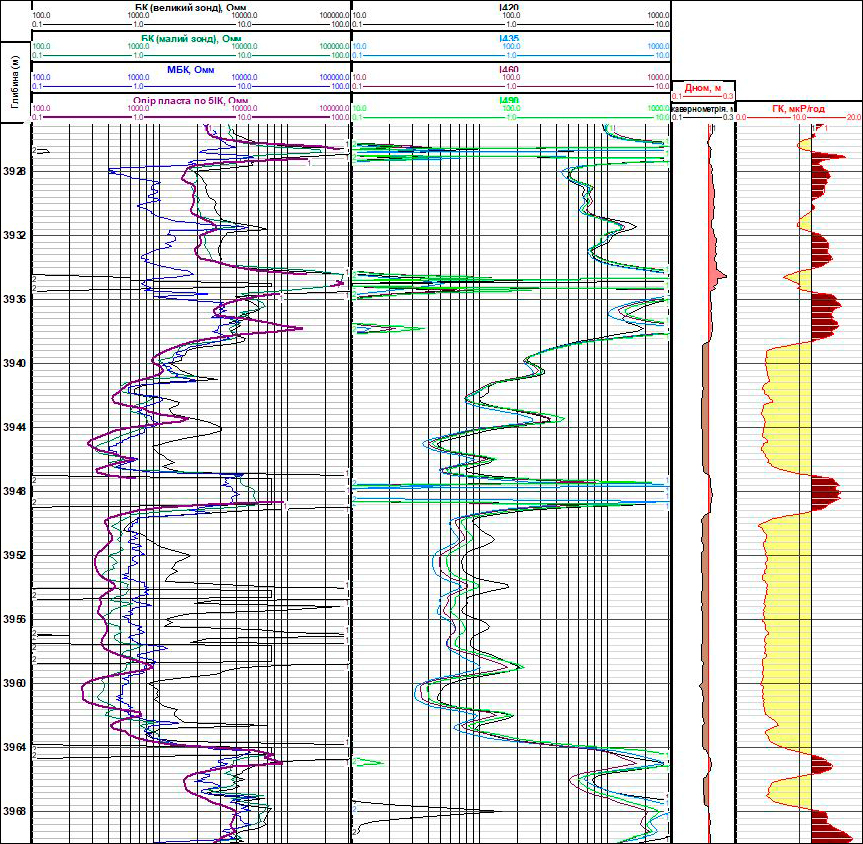
Dual Induction tool presents active and reactive components of formation conductivity. Based on conductivity curves we calculate the resistivity of formation. Transmitter coils induce an electromagnetic field in and around the borehole. Variation in the field, detected by the receiver coils, corresponds to variations in the conductivity in the formation adjacent to the tool.
|
As well, we have an Array Induction tool which measures apparent conductivities of the formation at five different depths of investigation from 20” to 90”. (active and reactive components): 3И0.3; 3И0.5; 3И0.85; 3И1.26; 3И2.05. After application of necessary borehole correction, the conductivities become converted into resistivities of Rt and Rxo, which are presented at vertical resolutions of 2 ft and 4 ft. Corrections are applied to remove the borehole effects. With this method we can solve the following tasks: - lithology differentiation;
- measure Rxo and Rt;
- estimate reservoir saturation.
|
 |
The advantage of induction tools is that arrays shouldn’t have direct contact with mud fluid so the log becomes most suitable in high-resistive mud systems, e. g. oil-based and freshwater mud or air-filled holes.
Operational P-T conditions:
 |
MAX |  |
MAX | |
| 150; 175 °C | 100; 120; 150 MPa |