





Gamma ray logging is a method of measuring naturally occurring gamma radiation to characterize the rock or sediment in a borehole. The source if natural gamma radiation can be radioactive isotopes in clays, groundwater, and organic matter. Gamma ray log is the simplest and the most convenient method to work with. Hence, it is obligatory to register it in all wells.
Gamma ray logging solves the following tasks:
|
- reservoir identification; - lithology differentiation; - volume of shale calculation; |
- correlation of well logs; - waterflooded beds; - channeling identification. |
|
Natural gamma ray spectrometry. Different types of rock emit different amounts and different spectra of natural gamma radiation. Spectral logging is the technique of measuring the spectrum, or number and energy, of gamma rays emitted via natural radioactivity of the rock formation. There are three main sources of natural radioactivity on Earth: potassium (40K), thorium (principally 232Th and 230Th), and uranium (principally 238U and 235U). These radioactive isotopes each emit gamma rays that have a characteristic energy level measured in MeV. Simultaneously we calculate the following elemental ratios: Th/U, U/K, Th/K which allow us to do the following: - deduct uranium content for correct Vshale calculation; - define possible fracturing zones; - identify intervals with high organic matter content; - more precise correlation of well logs; - identify specific clay types. |
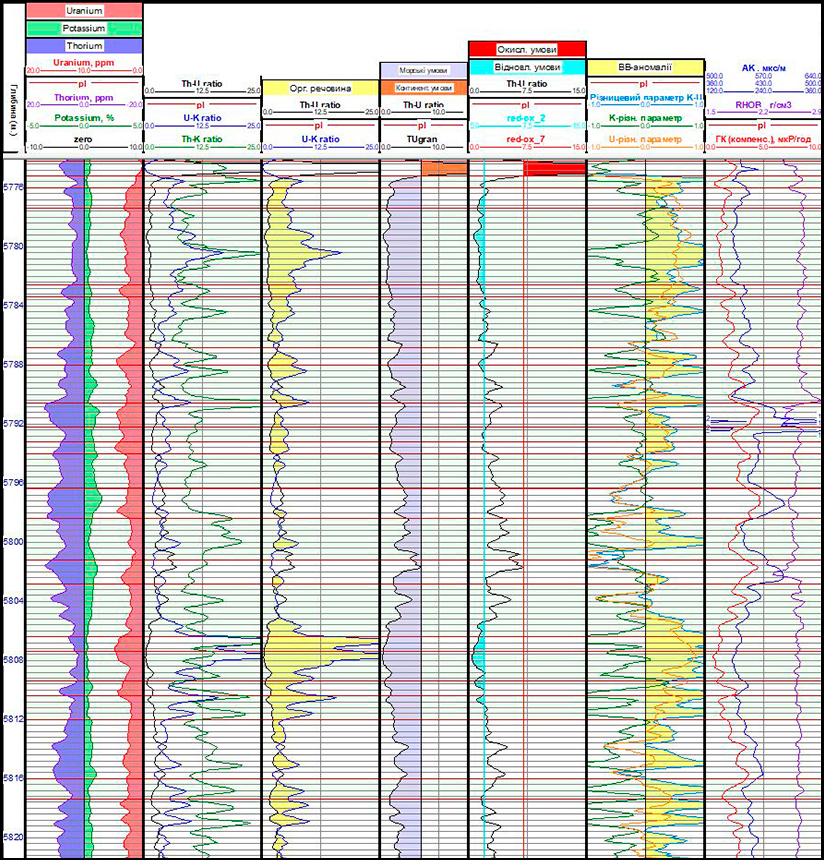 |
It should be mentioned that one of the advantages of this method is that almost nothing influences its readings, except drilling mud with complex chemical composition, such as biocar, polimer-potassium, etc. That’s why it will be obligatory to make corrections according to the data of chemical composition provided by the Customer from the well.
Operational P-T conditions:
 |
MAX |  |
MAX | |
| 150; 175 °C | 120; 150 MPa |